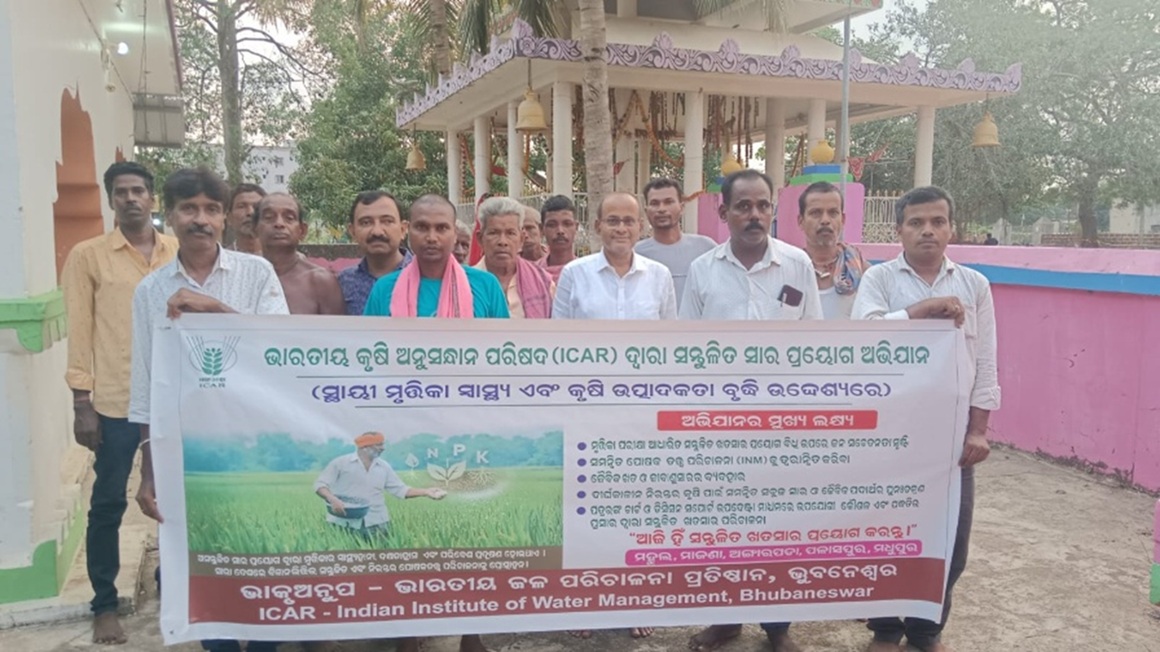
Under the MGMG Programme (Team-2), scientists from ICAR-IIWM organized a farmer awareness and capacity-development programme on 4th June 2026 at Chatabar village under Jatni Block, Khurda district. The programme focused on the themes of “Balanced Fertilizer Use and Scientific Nutrient Management” and the “Khet Bachao Abhiyan,” with the objective of promoting sustainable nutrient management practices for improved crop productivity and long-term soil health conservation. During the programme, the scientists emphasized the need for rational and need-based fertilizer application guided by soil test recommendations and crop nutrient requirements. They elaborated on the principles of the 4R Nutrient stewardship framework; applying the right nutrient source at the right rate, at the right time, and through the right method to enhance fertilizer-use efficiency and maximize crop response. The participants were also sensitized to the adverse impacts of excessive and unbalanced fertilizer application, including soil degradation, nutrient deficiencies and toxicities, rising cultivation costs, and environmental contamination. To promote sustainable farming, the scientists advocated the adoption of Integrated Nutrient Management (INM) practices by combining inorganic fertilizers with organic nutrient sources such as farmyard manure, compost, vermicompost, and biofertilizers. The importance of maintaining soil organic matter and improving nutrient cycling for sustaining agricultural productivity was also highlighted. The programme concluded with a lively interaction session, during which farmers discussed the nutrient-related constraints encountered in their fields and sought expert guidance. The scientists provided location-specific, practical, and scientifically validated recommendations to address these challenges. A total of 19 progressive farmers from the village participated actively in the programme and benefited from the deliberations.