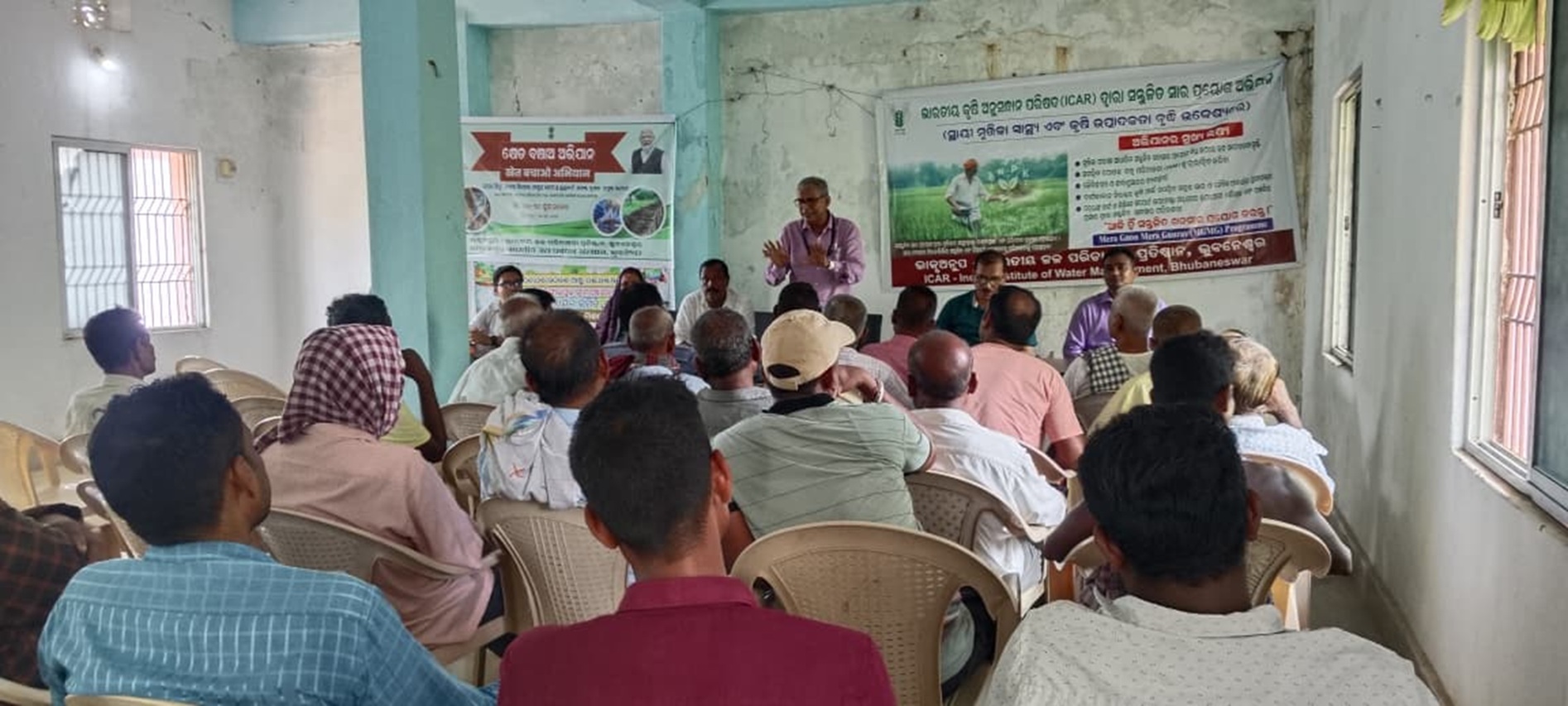
ICAR-Indian Institute of Water Management, Chandrasekharpur, Bhubaneswar organized an awareness-cum-training programme under the “Khet Bachao Abhiyan” on 8th June 2026 at the Bhingarpur Gram Panchayat Community Hall, Bhingarpur, Block: Balianta, District: Khordha, Odisha. A total of 74 farmers participated in the programme. The village Sarpanch, Sri Behera, along with other ward members, attended the programme. Dr. S.K. Jena, Dr. B. S. Satapathy, and Dr. Ranabir Chakraborty participated as resource persons. Rice-based cropping system was dominant in irrigated lands of the villages. Besides vegetables like pointed gourd, brinjal and cucurbits are major vegetables grown as cash crops. During the interaction Dr. S.K. Jena sensitized the participants on the objectives of the Khet Bachao Abhiyan and highlighted the importance of the “One Health” concept, emphasizing the interconnection between soil health, plant health, animal health, human health, and environmental sustainability. He also discussed various water conservation measures and climate-resilient agricultural practices for improving resource-use efficiency and enhancing resilience to climatic variability. Dr. B. S. Satapathy highlighted the importance of utilizing locally available organic resources and explained how dependence on imported fertilizers and agrochemicals can be reduced through the judicious integration of chemical fertilizers, organic manures, green manures, and biofertilizers. He emphasized the role of Integrated Nutrient Management (INM) in improving soil fertility, nutrient-use efficiency, and crop productivity. He further discussed the benefits of beneficial microorganisms such as Trichoderma, Pseudomonas, and other plant growth-promoting rhizobacteria (PGPR) in enhancing plant vigor, improving nutrient availability, and reducing reliance on chemical fertilizers and pesticides. He also elaborated on the multifaceted benefits of cow dung and cow urine as valuable on-farm resources for improving soil health and supporting sustainable farming systems under natural farming. Dr. Ranabir Chakraborty, elaborated the importance of soil-test-based nutrient management and the effective utilization of Soil Health Cards for scientific and balanced fertilizer application in agriculture. He explained the significance of maintaining soil organic carbon through the addition of organic residues and manures along with major nutrients, highlighting its crucial role in sustaining soil biological activity, supporting beneficial microorganisms, and improving long-term soil health and productivity. The farmers actively interacted with the scientists and discussed various challenges faced by them related to availability of seeds, organic manures, biofertilizers, bio stimulants, fertilizers and other inputs. We also discussed about the availability of various Govt. schemes and subsidies for the promotion of natural farming, organic farming and integrated farming system etc. The programme concluded with an appeal to adopt sustainable and resource-efficient farming practices for achieving healthy soils, healthy crops, environmental sustainability, and enhanced farm profitability under the Khet Bachao Abhiyan.