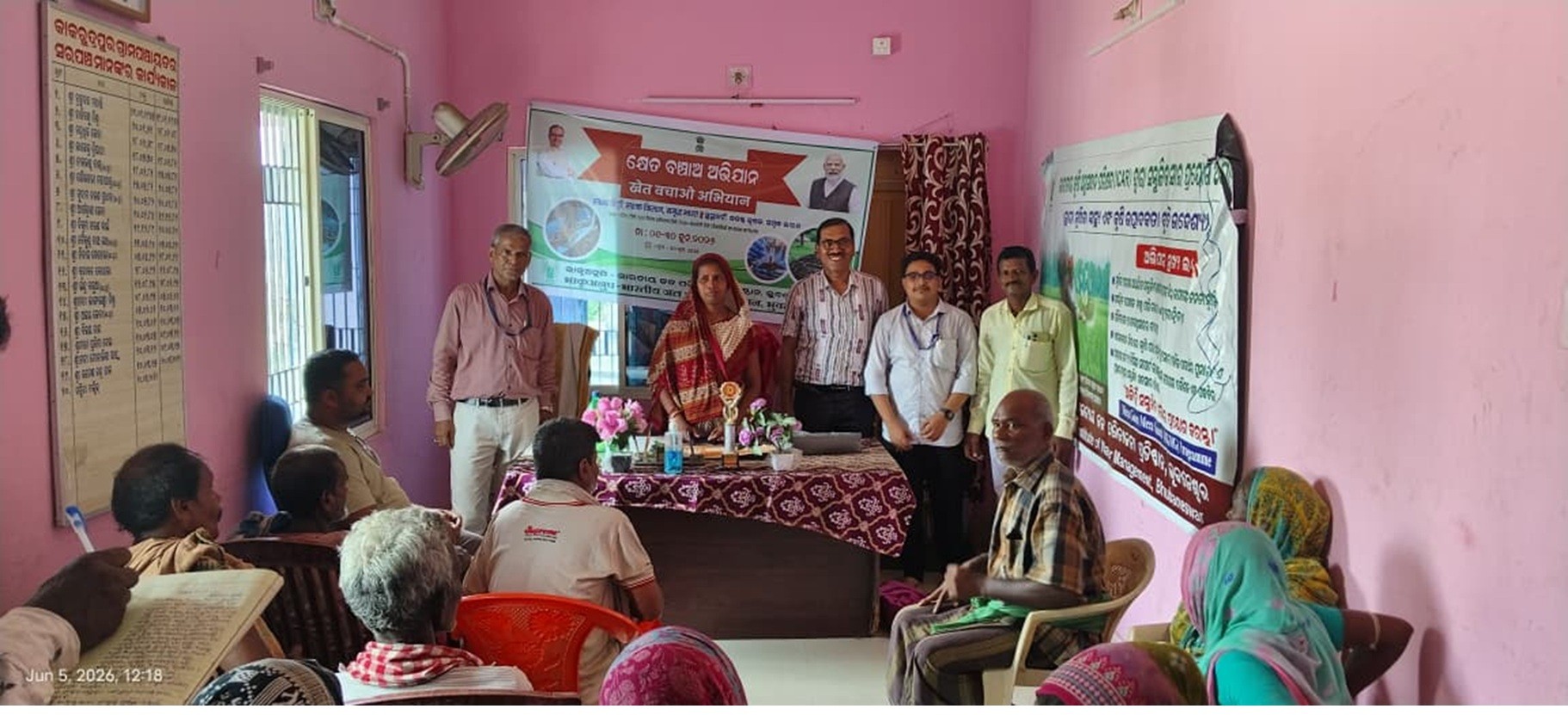
On the occasion of World Environment Day, ICAR-Indian Institute of Water Management, Chandrasekharpur, Bhubaneswar organized an awareness-cum-training programme under the “Khet Bachao Abhiyan” on 5th June 2026 at Village: Dewanpatna, Block: Balianta, District: Khordha, Odisha. Thirty-three farmers participated in the programme. Dr. S.K. Jena, Dr. B. S. Satapathy, and Dr. Ranabir Chakraborty attended the programme as resource persons.The programme highlighted the importance of sustainable agriculture in conserving natural resources, protecting the environment, and ensuring long-term farm profitability. Addressing the gathering, Dr. S.K. Jena emphasized the critical role of water conservation and climate-resilient agricultural practices in addressing the challenges posed by climate change. He encouraged farmers to adopt resource-conserving technologies and efficient water management practices to enhance resilience against climatic variability while safeguarding soil and water resources. In line with the objectives of the Khet Bachao Abhiyan, he also advocated for healthier lifestyles through a reduction in edible oil consumption, thereby contributing to improved public health and reduced dependence on imported edible oils. Dr. B. S. Satapathy highlighted the importance of Integrated Nutrient Management (INM) through the judicious integration of chemical fertilizers, organic manures, green manures, and biofertilizers for enhancing soil fertility, nutrient-use efficiency, and crop productivity. He encouraged farmers to adopt natural farming practices using Jeevamrit, Ghanajeevamrit, and other locally available bio-inputs prepared from cow dung, cow urine, neem, karanj, bale and tulasi leaves for environmentally safe pest management. He further emphasized the need to reduce dependence on external inputs and promote resource-based farming systems for maintaining healthy soils, ecological balance, and sustainable agricultural production. Dr. Ranabir Chakraborty stressed the importance of soil-test-based nutrient management and the effective utilization of Soil Health Cards for scientific and balanced fertilizer application. He explained how balanced fertilization can improve nutrient-use efficiency, reduce unnecessary fertilizer consumption, lower cultivation costs, and sustain soil health. A practical demonstration on seed treatment and biofertilizer application was also conducted, highlighting their role in enhancing crop productivity, improving soil biological activity, and promoting eco-friendly and sustainable crop production systems.The programme concluded with an appeal to adopt environmentally responsible agricultural practices for conserving soil, water, and biodiversity while ensuring sustainable and profitable farming under the Khet Bachao Abhiyan.